
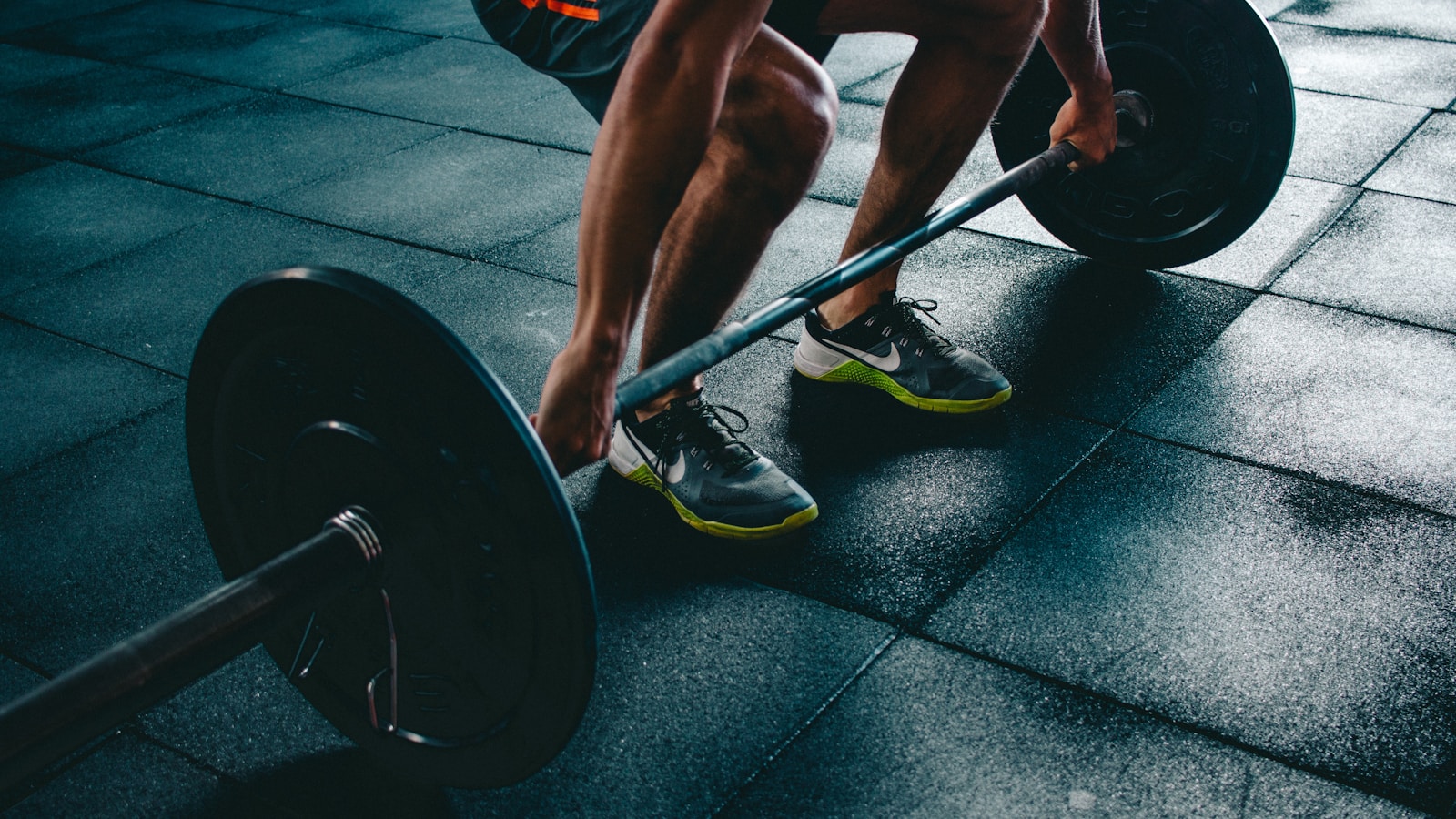
The hard part of a beginner strength training routine is not the exercises. It is choosing fewer of them, doing them more consistently, and resisting every YouTube video that promises a "perfect 12-exercise back day." Real beginner strength is built on five lifts, three days a week, for six to twelve months. Anyone who tells you you need more is either selling something or has forgotten what beginner means.
Why "five lifts, three days a week" actually works
Three principles run beneath all good beginner programmes:
- Progressive overload — slightly more weight, reps, or quality each week. Without it, you maintain; with it, you grow.
- Recovery — strength is built during rest, not during training. Three days a week leaves enough recovery for everything to happen.
- Compound movements — full-body lifts hit more muscle per minute and produce the strength carryover that translates into real-world capability.
The five lifts below cover the entire body, train every major movement pattern, and demand far less time than a "bro split" of ten exercises a session.
The five lifts
1. Goblet squat (working up to back squat)
The squat is the foundation. Beginners start with a goblet squat — holding a single dumbbell or kettlebell at the chest. It teaches an upright torso, gives instant feedback if your form drifts, and is gentler on the lower back while you learn.
Form cues: feet shoulder-width apart, toes slightly out, knees track over the toes (not collapsing inward), depth at least until your hips drop below your knees. Sit back, not down.
2. Hinge: Romanian deadlift (RDL)
The hip hinge teaches the back of the body — hamstrings, glutes, lower back. Start with a pair of dumbbells held in front of the thighs.
Form cues: push the hips back, keep a slight bend in the knee (not a full squat), spine neutral, dumbbells slide down the leg, stop when the hamstrings tell you to. Reverse by squeezing the glutes.
Common mistake: trying to bend the knees as the hips go back — that's a squat. RDLs are knees almost still, hips going back.
3. Push: dumbbell bench press (or push-up)
The horizontal push pattern. If you have a bench and dumbbells, the bench press is the gold standard. If not, push-ups in good form are a perfectly legitimate beginner alternative.
Form cues: shoulder blades pulled together and down (think "tucked into back pocket"), elbows at roughly 45 degrees from the body (not flared at 90), control the descent.
4. Pull: one-arm dumbbell row
The horizontal pull. Most beginners are over-developed in the front (chest, shoulders) from desk life and under-developed in the back. The row corrects this.
Form cues: one knee and one hand on a bench (or chair), opposite leg planted on the floor. Pull the dumbbell to the hip, not the chest. Squeeze the shoulder blade at the top. Lower under control.
5. Carry: farmer's carry
The unsung hero of beginner programmes. Pick up a pair of dumbbells (or kettlebells). Walk in a straight line with your shoulders pulled back and your core braced. 30–40 seconds at a load that gets heavy by the end. Builds grip, core, posture, and traps better than any "core circuit."
The schedule (three days a week)
Two simple workouts you alternate:
Workout A
- Goblet squat — 3 sets of 8
- Dumbbell bench press (or push-up) — 3 sets of 8
- One-arm row — 3 sets of 10 each side
- Farmer's carry — 3 walks of 30 seconds
Workout B
- Romanian deadlift — 3 sets of 8
- Push-up (or dumbbell bench press) — 3 sets of as many as possible with good form
- One-arm row — 3 sets of 10 each side
- Farmer's carry — 3 walks of 30 seconds
Weekly plan
- Monday: A
- Wednesday: B
- Friday: A
- Next week: B-A-B
Total session time: 30–40 minutes including warm-up. That is the entire programme. Run it for three months and you will be unrecognisably stronger than you are today.
Progression: how to actually get stronger
The simplest beginner progression — increase the load by the smallest available increment whenever you complete all the prescribed reps with good form on the last set. For dumbbells, that is usually 1–2 kg. For barbells later on, 2.5 kg. For bodyweight, add a rep before adding load.
Bad weeks happen. If you cannot hit the reps for two sessions in a row, drop the weight 10% and rebuild. The graph goes up over weeks and months, not within a week.
Warm-up that earns its place
Five minutes of:
- Light cardio (rowing, jog in place, jumping jacks).
- 5 cat-cows.
- 10 bodyweight squats.
- 10 hip hinges with no weight.
- 10 shoulder pass-throughs with a band or towel.
- One light warm-up set on whatever the day's first big lift is.
Skip the elaborate "activation" routines for now. They are not bad, but they steal time from actually lifting, which is what builds strength.
Common beginner mistakes
- Jumping to "intermediate" programmes too early. Beginners can add weight every session for months — this is a gift. Spend it. Intermediate splits assume that gift has run out.
- Adding cardio fatigue without recovery. Heavy CrossFit-style metcons on lifting days slow strength progress at the beginner stage. One walk a day is fine; three HIIT classes a week on top of strength is a recipe for stalling.
- Eating like a competitive marathoner. You do not have to bulk like a powerlifter, but you do have to eat enough protein (1.6–2g per kg of bodyweight) and not run a punishing calorie deficit while learning to lift.
- Skipping sleep and complaining about progress. Six hours a night and you will not get stronger no matter how perfect the programme is.
- Watching too many lifting videos. Five hours of YouTube produces zero gains. One hour in the gym produces real ones.
Home or gym?
Both work. A pair of adjustable dumbbells (5–25 kg), a sturdy bench, and 10 m of clear floor space cover the entire programme above for the first 6–9 months. After that, a barbell and a power rack make further progress smoother and cheaper than a gym subscription if you intend to keep training long-term.
The gym wins on social motivation, weight selection, and the existence of someone qualified to spot a form issue. Pick whichever you will show up to three times a week. The best programme is the one your knees and your calendar both agree to.
Bottom line
A beginner strength training routine in 2026 is squat, hinge, push, pull, carry — three days a week — for at least three months before changing anything. That is the entire prescription. Skip the bro splits, the 12-exercise sessions, and the supplement industry. Add weight slowly, eat enough protein, sleep seven hours. Six months from now you will look back at the version of yourself that wanted a more "advanced" programme and be quietly grateful you did the boring one.